

Marxism Unmasked: From Delusion to Destruction
Produktdetails
| Artikelnummer | 237130932 | Erscheinungsdatum | 2026/07/10 | Listenpreis | €4.20 | Modellnummer | 237130932 | ||
|---|---|---|---|---|---|---|---|---|---|
| Kategorie | |||||||||
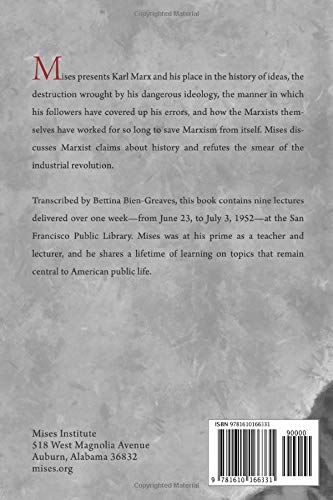
We can't sit under Mises at his famous Vienna private seminar. We can't go back in time and attend his New York seminar, or follow him to his speaking engagements that he held in the 50s and 60s.But thanks to this second volume in a thrilling series (here is volume one), we do have access to what he said. He is warm, funny, passionate, and learned. This book provides a candid look at the man and his teaching style. It demonstrates his dazzling command over the material, and teaches in a breezier way than his treatises.This volume contains nine lectures delivered over one week, from June 23, to July 3, 1952, at the San Francisco Public Library. Mises was at his prime as a teacher and lecturer. He shares a lifetime of learning on topics that were (and remain) central to American public life.As the title indicates, his main focus is on Marxism. He discusses Marx and his place in the history of ideas, the destruction wrought by his dangerous ideology, the manner in which his followers have covered up his errors, and how the Marxists themselves have worked for so long to save Marxism from itself. He discusses Marxist claims about history and refutes the smear of the industrial revolution.The approach is systematic but casual. So the reader encounters wonderful insights in the form of short asides. For example: "The worst thing that can happen to a socialist is to have his country ruled by socialists who are not his friends."As a lecturer, he is steady and relentless. The reader can nearly "hear" him speaking through the prose. And there are times when Mises reveals a level of rhetorical passion that you would never encounter in print. That's because what is printed here are not pre-prepared lectures in the sense that they were written out. They were transcribed by Bettina Bien Greaves from what he actually said.Thus can we hear this passage:It is not true, as Marx said, that the improvements in technology are available only to the exploiters and that the masses are living in a state much worse than on the eve of the Industrial Revolution. Everything the Marxists say about exploitation is absolutely wrong! Lies! In fact, capitalism made it possible for many persons to survive who wouldn't have otherwise.Some readers of Mises's larger works have said that while his rigor is dazzling, the man himself can seem remote. Whether or not you agree with this observation, Mises comes across in these lectures as brilliant but very warm and charming in an old world sense.This approach is particularly fruitful in the last four of the lectures, which cover topics such as savings, interest, inflation, profit and loss, and the place of foreign investment. The lecture on interest rates, for example, must surely rank as one of the best explanations of this complicated topic. He recounts the history of the attempt to suppress interest rates, from the ancient world to the modern period. He explains why this cannot work because interest is merely the objective sign of a phenomenon that is integral to human action. As he moves on to money, Mises reveals himself to be tougher on the issue of fiduciary media than he was when he wrote his 1912 book The Theory of Money and Credit.In response to a question Mises says: "In the future no additional banknotes should be issued, no additional credit should be entered on a bank subject to check, unless there is 100 percent coverage in money."Also not to be missed is Mises's wry defense of "money cranks": at least they were only more consistent than the advocates of Keynesian and monetarism.Mises was clearly pressed for time, so he had to be at once thorough and move quickly through the material. It's still not "light reading" by the normal standards, but for people who want to see a great mind at work, this has a wonderful element of spontaneity about it that attracts and teaches at the same time. Read more
Korrektur der Produktinformationen
Wenn Sie Unvollständigkeiten oder Fehler in den Produktinformationen auf dieser Seite bemerken, nutzen Sie bitte das Korrekturformular unten.
Korrekturanfrage